
Northern fowl mites (Ornithonyssus sylviarum) are the most economically damaging ectoparasite of poultry in North America (Murillo and Mullens, 2017). They complete their entire life cycle on the host, which accelerates population growth and makes early detection critical.
Adult mites are around 0.75–1 mm, dark reddish-brown, and just visible to the naked eye. They concentrate in the vent region, where droppings and cast skins form a dark crust at the base of feathers (Cobb Breeder Management Guide, 2022). Infestations are worst in cool weather and in young, naive birds. Main introduction routes include wild birds, egg flats, and equipment. Adults can survive off-host for up to four weeks (Mullens et al., 2009).
Northern Fowl Mites vs Red Mites
The poultry red mite (Dermanyssus gallinae) is found in roughly 90% of European layer facilities (Murillo and Mullens, 2020). It hides in cracks and nest boxes by day and feeds only at night. Northern fowl mites spend their entire life cycle on the bird, so a daytime vent inspection is sufficient to detect them. Red mite requires nighttime checks or off-host environmental sampling.
Production Impact
Heavy infestations drain up to 6% of a hen‚s blood volume per day (DeLoach and DeVaney, 1981), causing anemia, weight loss, pale combs, and egg production drops of 10% or more (Mullens et al., 2009). Feed conversion also deteriorates as immune activation diverts resources from growth (Murillo et al., 2016). In breeder flocks, hens avoid infested nests, increasing floor eggs and reducing hatchability (Cobb Breeder Management Guide, 2022). In pullets, declining flock uniformity or stalled average daily gain can be an early automated indicator of growing mite pressure in the house.
Can Northern Fowl Mites Live on Humans?
Northern fowl mites cannot establish a lasting infestation on humans. Workers handling infested birds may experience temporary pruritic skin reactions from transient bites (Cafiero et al., 2018), resolving once contact with birds is removed.
How to Get Rid of Northern Fowl Mites: Treatment and Prevention
Approved acaricides include permethrin, tetrachlorvinphos, carbaryl, and spinosad (Cobb Breeder Management Guide, 2022). Treatments should not exceed one application every 14 days. Resistance to organophosphates and pyrethroids is widespread (Mullens et al., 2004), making spinosad increasingly important. Diatomaceous earth (DE) is a non-chemical option approved for organic systems. Applied to house surfaces, cages, nest boxes, and litter, it targets mites in the environment directly (Bennett et al., 2011). DE-filled dustboxes also enable self-treatment through dustbathing, reducing ectoparasites on user hens by 80 to 100% within one week (Martin and Mullens, 2012), and birds with access to DE-treated litter can suppress mite burdens through natural dustbathing (Murillo and Mullens, 2016). Early action remains decisive: a single acaricide application clears 85% of light infestations versus 24% of heavy ones (Mullens et al., 2009).
Biosecurity is equally important. Exclude wild birds from nesting near houses, disinfect equipment and egg flats between farms, and treat walls, cracks, and nest boxes during every downtime period.
Weighing as a Detection Tool
Mite pressure impacts growth performance in pullets before clinical signs appear, especially in red mite infestations. The BAT2 Connect automatic poultry scale records individual weights throughout the day, giving managers a continuous performance signal at the flock level to detect declining trends early.
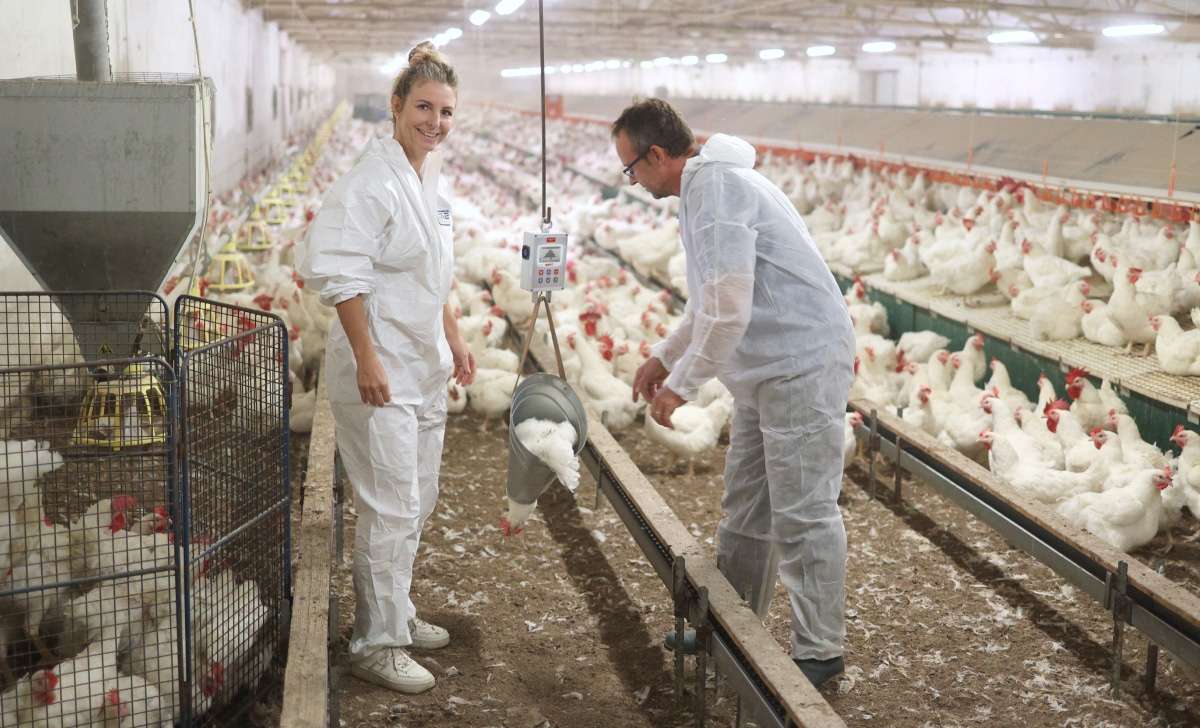
Manual weighing adds what automation cannot. Each bird is caught individually during routine hands-on weighing, giving the handler a direct opportunity to inspect the vent area for soiled feather debris, a key early sign of mite infestation. Each session becomes a built-in welfare check. The BAT1 manual poultry scale makes this individual bird assessment a standard part of the weighing process. Data from both tools can be reviewed together in BAT Cloud for flock comparison and timely action.
Mites spread fast. Catching them early, whether through weight data or direct handling, is the difference between a manageable problem and a costly one.
References
- Cafiero, M.A., Viviano, E., Lomuto, M., Raele, D.A., Galante, D. and Castelli, E. (2018). Dermatitis due to Mesostigmatic mites in residential settings. Journal der Deutschen Dermatologischen Gesellschaft, 16(7), 904–906. https://doi.org/10.1111/ddg.13565
- Cobb Vantress (2022). Cobb Breeder Management Guide. Cobb-Vantress, Inc. https://www.cobb-vantress.com/resources/management-guides/
- DeLoach, J.R. and DeVaney, J.A. (1981). Northern fowl mite, Ornithonyssus sylviarum (Acari: Macronyssidae), ingests large amounts of blood from White Leghorn hens. Journal of Medical Entomology, 18(5), 374–377. https://doi.org/10.1093/jmedent/18.5.374
- Mullens, B.A., Owen, J.P., Kuney, D.R., Szijj, C.E. and Klingler, K.A. (2009). Temporal changes in distribution, prevalence and intensity of northern fowl mite (Ornithonyssus sylviarum) parasitism in commercial caged laying hens, with a comprehensive economic analysis of parasite impact. Veterinary Parasitology, 160(1–2), 116–133. https://doi.org/10.1016/j.vetpar.2008.10.076
- Mullens, B.A., Velten, R.K., Hinkle, N.C., Kuney, D.R. and Szijj, C.E. (2004). Acaricide resistance in northern fowl mite (Ornithonyssus sylviarum) populations on caged layer operations in southern California. Poultry Science, 83(3), 365–374. https://doi.org/10.1093/ps/83.3.365
- Murillo, A.C., Chappell, M., Owen, J.P. and Mullens, B.A. (2016). Northern fowl mite (Ornithonyssus sylviarum) effects on metabolism, body temperatures, skin condition, and egg production as a function of hen MHC haplotype. Poultry Science, 95(11), 2536–2546. https://doi.org/10.3382/ps/pew175
- Murillo, A.C. and Mullens, B.A. (2016). Timing diatomaceous earth-filled dustbox use for management of northern fowl mites (Acari: Macronyssidae) in cage-free poultry systems. Journal of Economic Entomology, 109(6), 2572–2579. https://doi.org/10.1093/jee/tow165
- Murillo, A.C. and Mullens, B.A. (2017). A review of the biology, ecology, and control of the northern fowl mite, Ornithonyssus sylviarum (Acari: Macronyssidae). Veterinary Parasitology, 246, 30–37. https://doi.org/10.1016/j.vetpar.2017.09.002
- Murillo, A.C. and Mullens, B.A. (2020). Collecting and monitoring for northern fowl mite (Acari: Macronyssidae) and poultry red mite (Acari: Dermanyssidae) in poultry systems. Journal of Insect Science, 20(6), 12. https://doi.org/10.1093/jisesa/ieaa032